A&D manufacturing is seeing a historic surge and OEMs are ordering more than ever, but paperwork limits how fast shops can accept more work. It starts with every incoming PO being reviewed to avoid costly discrepancies. Once parts are actually built, they can't be shipped and invoiced until a FAIR is generated and approved.
According to an article by Deloitte's Industry Outlook, there is limited production and overhaul capacity along with increasing workforce pressures for aerospace and defense manufacturers.
Additionally, US manufacturing is growing at a rapid pace and so is the need for more skilled workers to support it. This is great news for American manufacturers. However, with the increase in production volume and the gap in available skilled workers, more OEMs, primes, and suppliers are seeking out new solutions to fill that gap.
Aerospace and defense volume is returning to American shops faster than people can keep up. That gap won't close through hiring alone, so which parts of the work can a shop automate?
The bottleneck

Airbus delivered 65% of the orders it had taken and Boeing had a backlog of 6,755 aircraft at the end of August 2026. On the defense side, an article by Oliver Wyman states that rising demand and ongoing conflicts are likely to push the backlog to almost $900 billion, while the industry keeps struggling with "finding, training, and retaining the expertise required to scale production."
Buying another machine does not clear a backlog on its own. The real challenge is finding someone who can set up and machine the part and who also knows the quality process required to ship it out.
In order for a part to be cleared for delivery, there are several steps: the drawing and engineering behind it, purchase orders going out to suppliers, agreeing on the PO and quote, the build itself, the quality assurance that follows, and more.
A lot of those steps still happen by hand. That said, most part rejections are clerical issues rather than dimensional: a characteristic with no recorded value, an unsigned form, a part number typo, a cert written against a superseded spec. Oftentimes, the part is fine but the documentation associated with it is not, so the shipment is stalled.
Labor shortage
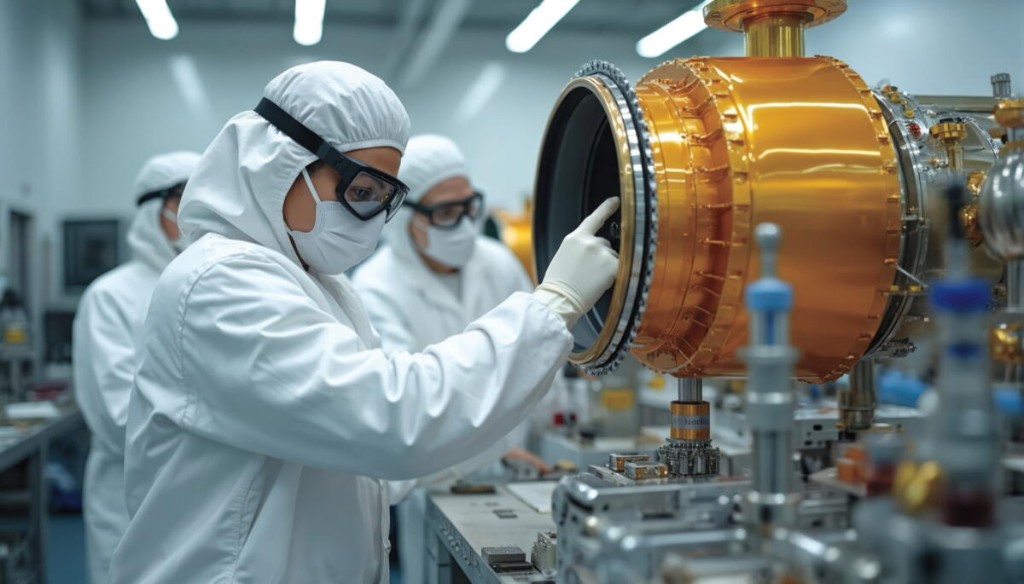
Hiring more people to support the influx of orders seems like the obvious next step. However, the number of available workers in the field who understand quality, how manufacturing works, and the compliance process is not increasing at the same rate as the growing number of parts needed.
According to the Bureau of Labor Statistics, there were 602,000 quality control inspectors in 2025 and that number is expected to grow by just 3% through 2035. A new inspector can measure a part within a couple of weeks, but putting together a package a particular prime signs off on the first time is something people pick up over years with that customer. Oliver Wyman reached the same conclusion after conducting a survey: "Hiring is crucial, but companies will first need to increase output from their current workforce and assets to make measurable progress in solving labor problems."
Next steps
With advances in technology and AI, there are several tools readily available for aerospace and defense manufacturers to automate their daily processes and build parts faster.
An ERP (Enterprise Resource Planning) system is the software a shop runs its daily operations on. It's usually the backbone, holding jobs, routers, purchasing and shop floor data together. Epicor Kinetic, ProShop and JobBOSS all serve machine shops, and ProShop in particular builds a lot of AS9100 requirements straight into the workflow through its integration with GroundControl.
CAD and CAM sit upstream of everything else. CAD, or computer-aided design, is where the part gets drawn, and CAM, computer-aided manufacturing, turns that geometry into the toolpaths a machine follows. SolidWorks, CATIA and Siemens NX cover the design side, and Mastercam does a lot of the toolpath work.
Quoting software prices a job off the model and the drawing, pulling material, cycle time and margin into a single estimate rather than leaving an estimator to rebuild that math by hand every time. Paperless Parts is a commonly used software, and several ERPs have workable estimating built in. Other good examples of quoting software include Uptool or ProShop Chippy. The goal is to get a number back to the customer in a day without underbidding the job.
Then there's quality documentation. Platforms like HighQA, InspectionXpert and DISCUS have all been at this for years, mostly as desktop tools that balloon a drawing and export the AS9102 forms (ITAR-compliant AS9102 Software 2026).
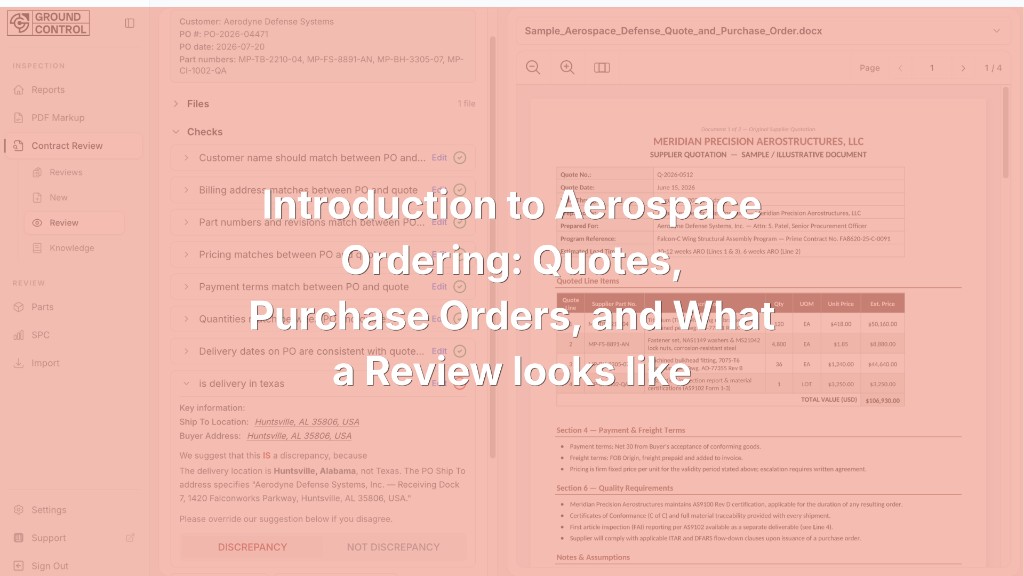
GroundControl is a First Article Inspection software that runs in AWS GovCloud and has achieved FedRAMP Moderate equivalency. FAI Generation auto-balloons the drawing and populates Forms 1-3. PO Review reads an incoming purchase order against the quote, or older PO, and reports the differences line by line. Manual processes that used to take hours are completed in minutes.
Conclusion
The backlog isn't going anywhere, and shops can't afford to wait for the hiring pool to catch up. What shops can control is how much time they hand back to their employees by automating the paperwork.
Targeted automation is the practical way in. Pick one process, count the hours it really takes today, then go look at what's built for it. PO review and first article documentation are usually the easiest places to start, since the work repeats and the rules are clear. The tooling has come a long way, and most of it is meant to sit alongside the ERP and CAD systems a shop already runs.
Hiring still matters and always will. But the suppliers who keep up with the technology will be the ones who get more out of the team they already have.